By morning, the storm had gone quiet, but Saltmarsh had not forgiven it.
The village woke under a sky the color of old tin. Roof tiles lay in the lanes like broken red shells. Nets hung from chimneys. A blue rowboat sat upside down in the churchyard, as if some giant child had grown bored and dropped it there. All along the harbor wall, people stood in their nightclothes and oilskins, saying very little.
Mara Vale stood barefoot in the doorway of her mother’s fish shop, holding a broom she had not used once. She was twelve years old and small for it, with tangled dark curls blown stiff by salt and a brown face dotted with freckles. Last night, the wind had screamed so loudly that the windows shook in their frames. Mara had lain awake under three blankets, counting the seconds between lightning and thunder, trying not to think of her father’s boat, which had vanished two winters ago on a much calmer sea.
Her mother, Selka, was picking bits of roof slate out of a crate of cod. She had a gray streak in her black hair that had not been there before Pa disappeared. This morning it looked brighter than ever. She worked quickly, jaw tight, but every few breaths she glanced toward the beach beyond the harbor, where a crowd was beginning to gather.
Mara noticed because everyone was looking that way.
Not at the smashed pier. Not at the cracked windows of the bakery. Not at the lighthouse lamp, which had gone dark sometime before dawn. Every face in Saltmarsh had turned past the leaning masts, past the wet dunes, toward Gullspit Beach.
“What is it?” Mara asked.
Selka did not answer at once. She brushed fish scales from her sleeve and stepped out into the lane. The air smelled of kelp, smoke, and something sharp, like rain on stone. Far away, a gull cried once and then stopped, as if it too had seen whatever waited on the sand.
Mara set down the broom. “Mam?”
Selka looked at her daughter, and for a moment Mara saw fear hiding behind her mother’s tired eyes. Not storm fear. Not money fear. Something older.
“Stay close,” Selka said.
They walked with the others through the village. Nobody pushed. Nobody shouted. Mr. Pelt from the bakery carried a lantern even though it was morning. Old Nan Ferris muttered prayers into the collar of her coat. Children who should have been racing through puddles held tight to their parents’ hands. The whole village moved like one creature, slow and stiff, drawn by a hook.
As they climbed the last dune, the wind dropped.
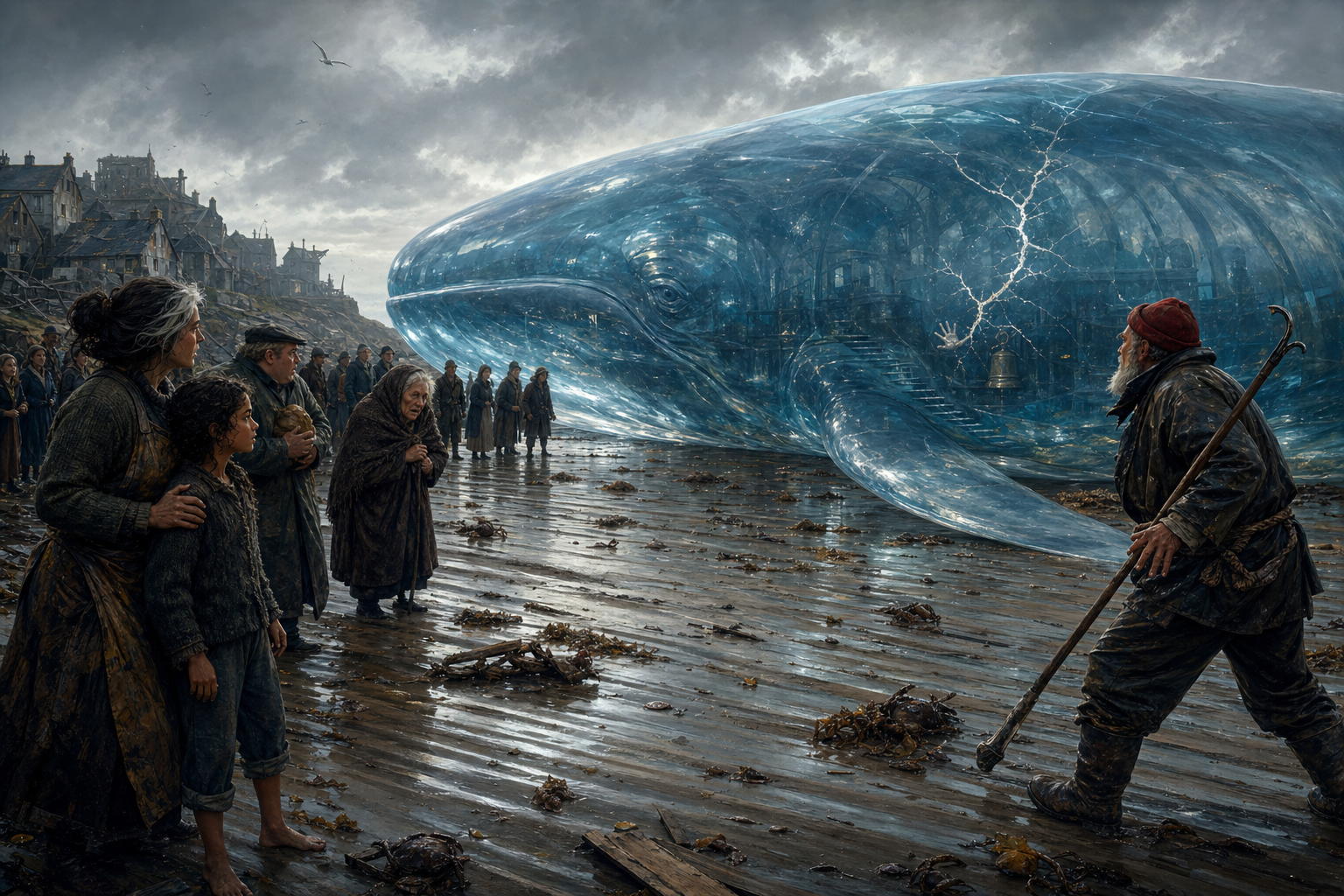
Mara had lived beside Gullspit Beach all her life. She knew its moods: silver on calm days, black during rain, gold under summer sun. But she had never seen it like this. The storm had dragged the sea far back, leaving the sand ribbed and shining. Tangles of weed lay everywhere. Crabs clicked among splintered planks. And in the middle of the beach, where no boat had any right to be, lay a whale the size of the ferry from Brightport.
It was made entirely of glass.
Mara stopped so suddenly that Selka’s hand tightened on her shoulder. The whale’s body rose higher than the harbor wall, smooth and clear and faintly blue, as if the sea itself had frozen into its shape. Its huge tail curved toward the dunes. One glass fin was buried deep in the sand. The great head faced the village, and its eye, larger than a cartwheel, was shut.
Inside the whale, shadows drifted.
At first Mara thought they were clouds reflected on its skin. Then she saw the clouds moving the wrong way. Thin shapes slid beneath the glass ribs, slow as sleep. Something like a staircase curled through the whale’s belly. Something like a bell hung where a heart might be. Light flickered deep within it, pale green and soft.
No one spoke for a long while.
Then Mr. Pelt whispered, “Saints preserve us.”
That broke the silence. The village burst into low talk all at once. Some said it must be a trick of ice. Some said smugglers. Some said no living thing should be clear enough to see through. A few people backed away. A few stepped closer, as if they had forgotten they were afraid.
Mara did not move. She was listening.
The sound came from inside the whale, so faint that the sea almost covered it. Music. Not a song she knew, not quite. It rose and fell like a music box turning underwater. There were notes like small bells, and notes like someone humming through closed lips. Each one tugged at Mara’s chest.
Selka’s hand slipped from Mara’s shoulder to her wrist. “Do you hear it?” Mara whispered.
Her mother’s face had gone pale. “Yes.”
“What is it?”
“I don’t know.” But Selka said it too quickly.
Down on the sand, Captain Orrin Pike pushed through the crowd with a coil of rope over one shoulder and his red cap pulled low. He had spent forty years telling the sea what he thought of it, and the sea had taken three fingers from his left hand in reply. He marched up to the whale as if he meant to scold it.
“Stand back,” he barked. “Glass breaks.”
Nobody argued. Captain Pike jabbed the whale’s side with the wooden end of a boat hook. The sound rang out across the beach, clear as a church bell. Not a dull tap. Not the thud of flesh. A bright, perfect note.
The music inside stopped.
Every person on the beach held their breath.
A crack appeared under the boat hook.
It was no longer than Mara’s finger at first. Then it raced upward in a silver line, splitting into smaller lines, branching like winter lightning. Captain Pike stumbled back. Mothers pulled children away. Selka yanked Mara hard enough to hurt, but Mara barely felt it. She was staring through the spreading crack.
Something moved behind it.
Not a shadow. Not a fish. A hand.
It pressed against the inside of the glass, pale and small, with five clear fingers spread wide. The palm flattened as if someone trapped inside was trying to push their way out. The music began again, louder now, but broken, like it was being played by shaking hands.
Mara’s heart slammed against her ribs. The hand was not huge like the whale. It was the size of a child’s hand.
The crack widened with a sharp, singing sound.
Then, from deep inside the glass whale, a voice whispered Mara’s name.